A pilot is not a customer.
Cleared is not the same as covered.
A clinical champion is not a budget holder.
Pressure Test asks the questions
before the room does.
Five questions. A verdict on your pitch. No coaching, no encouragement.
$8 a month after your first free session. No credit card required.
Healthtech pitches don't fail because the product is wrong.
They fail because the story has a gap the founder didn't know was there.
A Series A investor who has done deals in your category knows exactly where to push. A health system CIO who has survived enough failed implementations knows what procurement will ask. An FDA reviewer who has read a thousand submissions knows the difference between a regulatory strategy and regulatory vocabulary.
Peer feedback doesn't find these gaps. Generic pitch coaching doesn't know this space. One advisor hour with someone who does costs $300-500. They're rarely available the week before a meeting that counts.
Pressure Test was built for the week before that meeting.
Arvita Tripati
Founder, Vahana Labs
The question banks in Pressure Test come from health system procurement tables, diligence calls, and FDA pre-submission meetings. They were built from the pattern of what founders didn't prepare for, and what it cost them.
18 years as a VP-level operator at companies selling to health systems. Pitch judge at BioTools Innovator and MedTech Innovator. Mentor at Alchemist Accelerator, Plug and Play, and ReDesign Health. Three founding teams. Hundreds of pitches evaluated. She's been on the other side of that table.
Enterprise clients including Moderna, Gilead, NHS, and Bristol-Myers Squibb.
Credentials include: CISM. CIPM. RAC: Devices. CSQE. Babson MBA. Carnegie Mellon CDAIO.
Three steps.
Choose your interrogator
Select investor, enterprise buyer, or FDA reviewer. Answer two questions about your company and your specific meeting. The interrogator is assigned based on who you're actually pitching. A jaded healthtech specialist who has watched your category fail before is a different session than an emerging seed VC writing their first healthcare check.
The session
Paste your pitch script. Five questions, one at a time, typically under twenty minutes. If your answer is vague, the interrogator names it and asks again. That follow-up is not optional. It does not offer suggestions. It does not tell you what to fix. It evaluates.
The debrief
A verdict naming the primary gap. Paid sessions include the full findings: seven gap categories, each referenced to what you actually said, with routing to the Vahana Labs workshop or coaching engagement that addresses it.
Paid sessions include deck upload. The system reads your slides before the session starts and asks questions specific to your claims.
What the debrief looks like
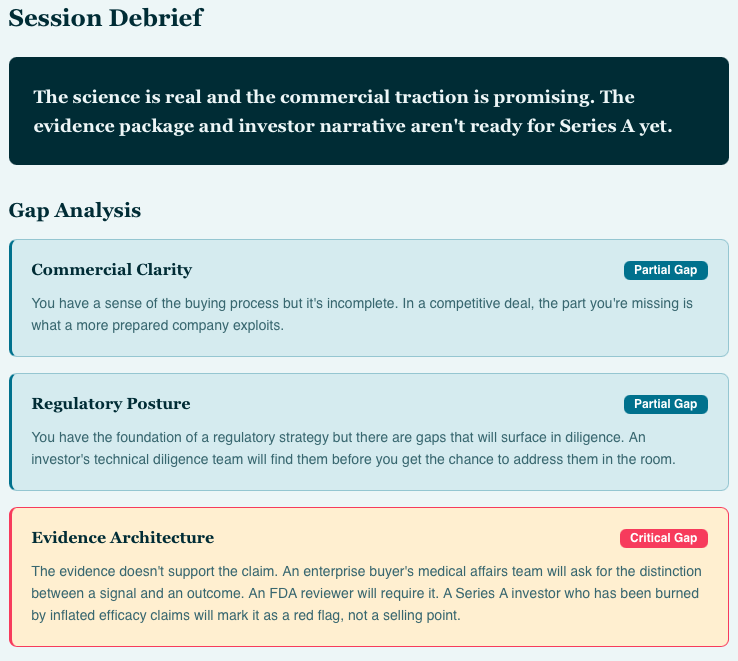
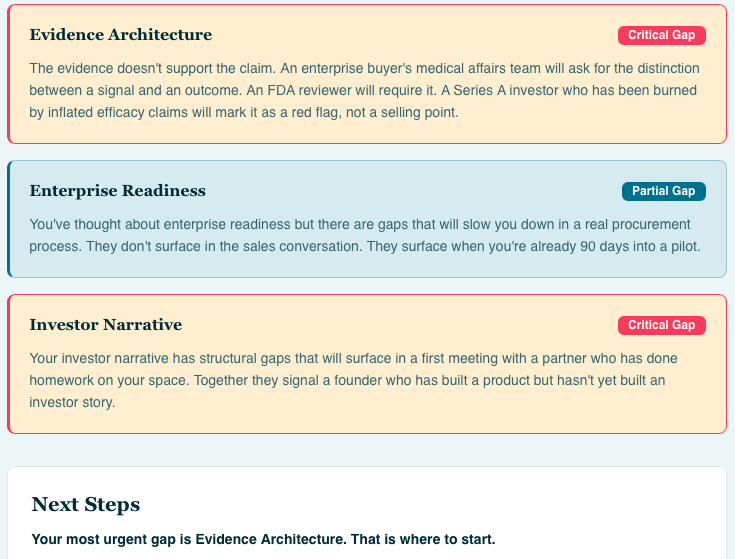
Here is what some of them sound like.
“I know this category. Convince me you’re different.”
“Your intended use statement — read it to me exactly as written. Every word matters.”
“Walk me through your reimbursement pathway. Which code, which payer, what’s the dollar amount, and who controls the access decision?”
“Is your algorithm locked or does it continue to learn after deployment?”
“Did FDA confirm your classification, or is that your team’s conclusion?”
The interrogator is assigned based on who you're actually pitching. You don't choose the questions.
The room won't name the gap.
It won't ask again.
It will move on.
“The evidence base has a real foundation but gaps in commercial clarity are the more immediate exposure: in a pharma procurement process, the person who approves a vendor relationship is rarely the person who wanted it.”
“The evidence doesn't support the claim. An enterprise buyer's medical affairs team will ask for the distinction between a signal and an outcome. An FDA reviewer will require it. A Series A investor who has been burned by inflated efficacy claims will mark it as a red flag, not a selling point.”
“You've thought about enterprise readiness but there are gaps that will slow you down in a real procurement process. They don't surface in the sales conversation. They surface when you're already 90 days into a pilot.”
Seven gap categories. Every session maps to these.
Commercial Clarity
Who is actually buying this?
Regulatory Posture
Is your FDA pathway defensible?
Evidence Architecture
Does your evidence match your claim?
Enterprise Readiness
Can you survive the full procurement process?
Investor Narrative
Can you answer the hard questions without going vague?
Reimbursement Strategy
Is there a confirmed mechanism for someone to pay for this?
Adoption and Change Management
What happens after the contract is signed?
Pro sessions include this.
Your prep plan
Build a procurement map for your furthest-along account.
Before any meeting where you reference a lead account, you need to know: the name and title of the person who controls the purchase order, what they have explicitly told you they need to see before signing, and what the current status of that conversation is. “They're interested” is not a status. If you don't know who controls procurement, that's the work, not the pitch.
Full prep plan available on Pro. $49/month.
Before you pay for advice
Know which advisor conversation is actually worth paying for.
One advisor hour in this space can cost $300–500. Pressure Test helps you prepare before you spend it.
Your pitch stays yours.
Session content is private and is not used to train AI models.
Read the full privacy policy →Free
Pressure-test one conversation
$0
Best for preparing for one investor, advisor, pilot, or buyer conversation.
- +One session
- +All three interrogator tracks
- +Pitch script input
- +Verdict line from the debrief
No credit card required.
Diagnosis
Most founders start hereBuild your commercial readiness map
$8/month
Best for founders actively working through pilot, procurement, evidence, regulatory, buyer, or enterprise-readiness gaps.
- +25 sessions per month
- +5 questions per session
- +Full debrief across all seven gap categories
Pro
Turn every session into a prep plan
$49/month
Best for founders who want more than a diagnosis: what to fix, what to say, and what to prepare before the next investor, advisor, pilot, buyer, or enterprise sales conversation.
- +Prep plan after every session
- +Everything in Diagnosis
- +Up to 10 questions per session
- +Readiness trends across sessions
Find out.